The short version
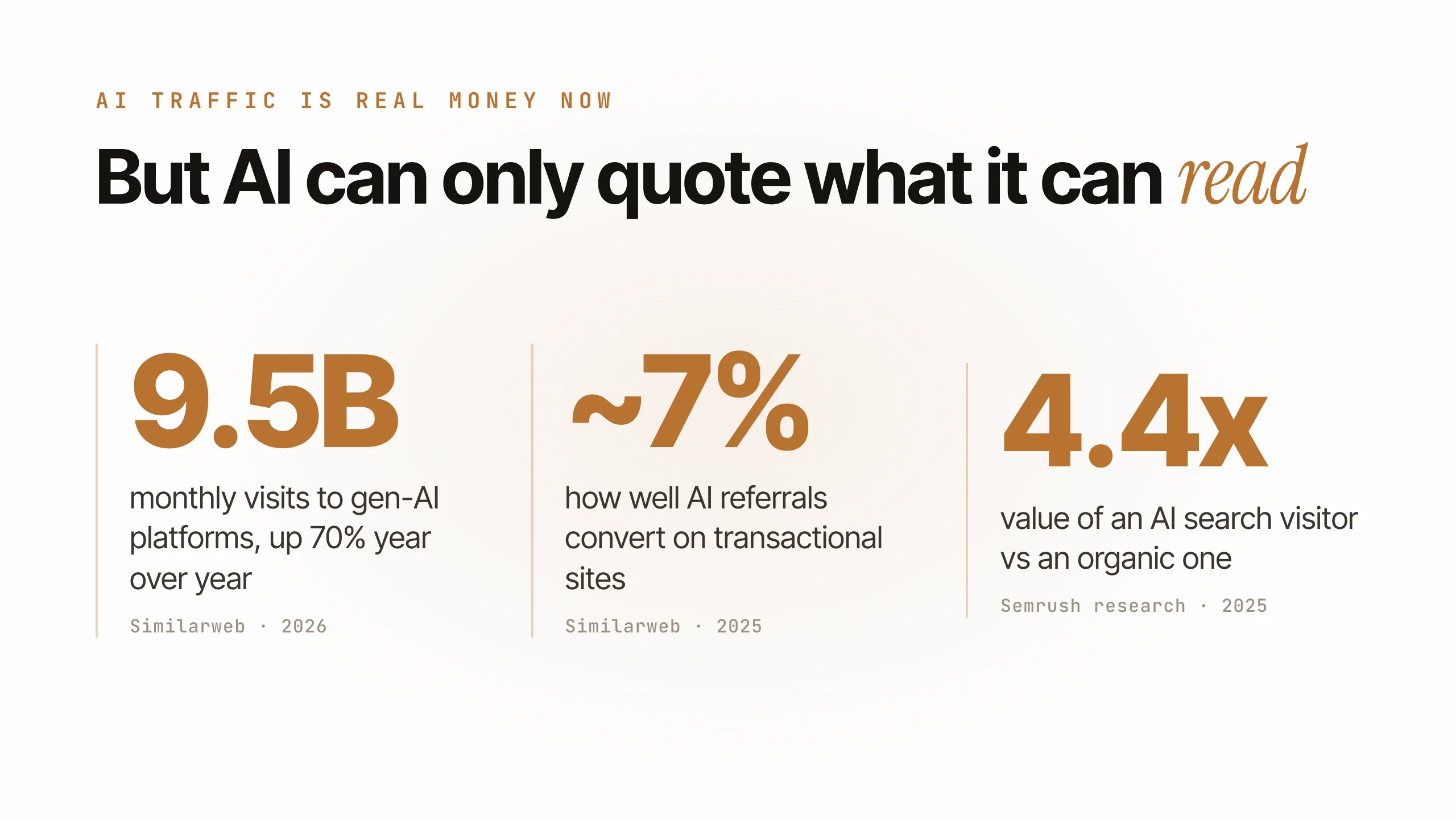
There are two AI visibility questions, not one. Off your site: does the AI name you. On your site: when it visits, can it lift a clean answer out. Almost everyone audits the first and ignores the second. The extraction gap is the distance between the AI landing on your page and the AI actually using your page. AI referral traffic is real money now, gen-AI platforms averaged 9.5 billion visits a month over the last year, up 70% (Similarweb, 2026), but AI can only quote what it can parse. If your best answer is buried under a long intro, vague headings, and ad breaks, the AI gives up and quotes a competitor's clearer page. You were on the list. You just were not extractable. The fix is not more content, it is less friction. Crawl your own site the way a machine reads it, find the pages where the answer is buried, and rewrite one page so the answer is findable up top. It costs nothing but attention, and almost nobody does it.
- You can win the ranking and still lose the citation. A page can rank in the blue links and still be too messy for an AI to quote.
- The extraction gap is the distance between the AI landing on your page and the AI actually lifting a clean answer out of it.
- AI traffic pays now. The average AI search visitor is worth 4.4 times the average organic one (Semrush research, 2025), and most brands have never audited that channel from the machine's side.
- LLMs read for structure, not tone. A clean H2 with the answer right under it is a gift. A clever heading is a wall.
- Crawl your own site like a machine, find the buried answers, and rewrite one page so the answer is extractable in the first two lines.
Everyone audits whether AI names them. Almost nobody audits whether AI can lift a clean answer off their page. Here is how to crawl your own site like a machine and close the gap. The goal is not to chase every AI tool. The goal is to build a useful marketing system that a real team can understand, repeat, and improve.
The extraction gap
Most people picture AI visibility as an off-site game. Does ChatGPT say my name, do I show up in the AI Overview, am I in the recommendation. Fair. But there is a quieter gap sitting one step earlier, on your own pages.
Here is the sequence people miss. The AI reaches your page. It tries to pull one clean, quotable answer out of it. If it can, you get cited. If it has to fight through a 400-word intro, a keyword-stuffed heading, and three ad breaks to find the one sentence that actually answers the question, it gives up and quotes the site that made it easy. You were on the list. You just were not extractable.
That is the extraction gap: the distance between the AI landing on your page and the AI actually using your page.
And the stakes went up this year, because AI traffic finally started paying. The average AI search visitor is worth 4.4 times the average organic visitor from a conversion standpoint (Semrush research, 2025). Half of US consumers who use AI say they have bought something after researching with it (Semrush research, 2025). This is not future money. It is money moving through a channel most brands have never once audited from the machine's side of the glass.
Why this matters: you can win the ranking and still lose the citation. Google and the LLMs are no longer asking what is the best page for this query. They are asking, in Search Engine Land's words, what answer can we construct, what sources support it, and what else does the user need (Search Engine Land, 2026). A page can rank in the blue links and still be too messy to quote. The blue link is a door. The clean answer is what gets carried out.
My take: the fix is not more content. It is less friction. The single highest-leverage AI-visibility move most people are skipping is to crawl their own site the way a machine reads it, find the pages where the answer is buried, and cut the burial. It costs nothing but attention, and almost nobody does it.
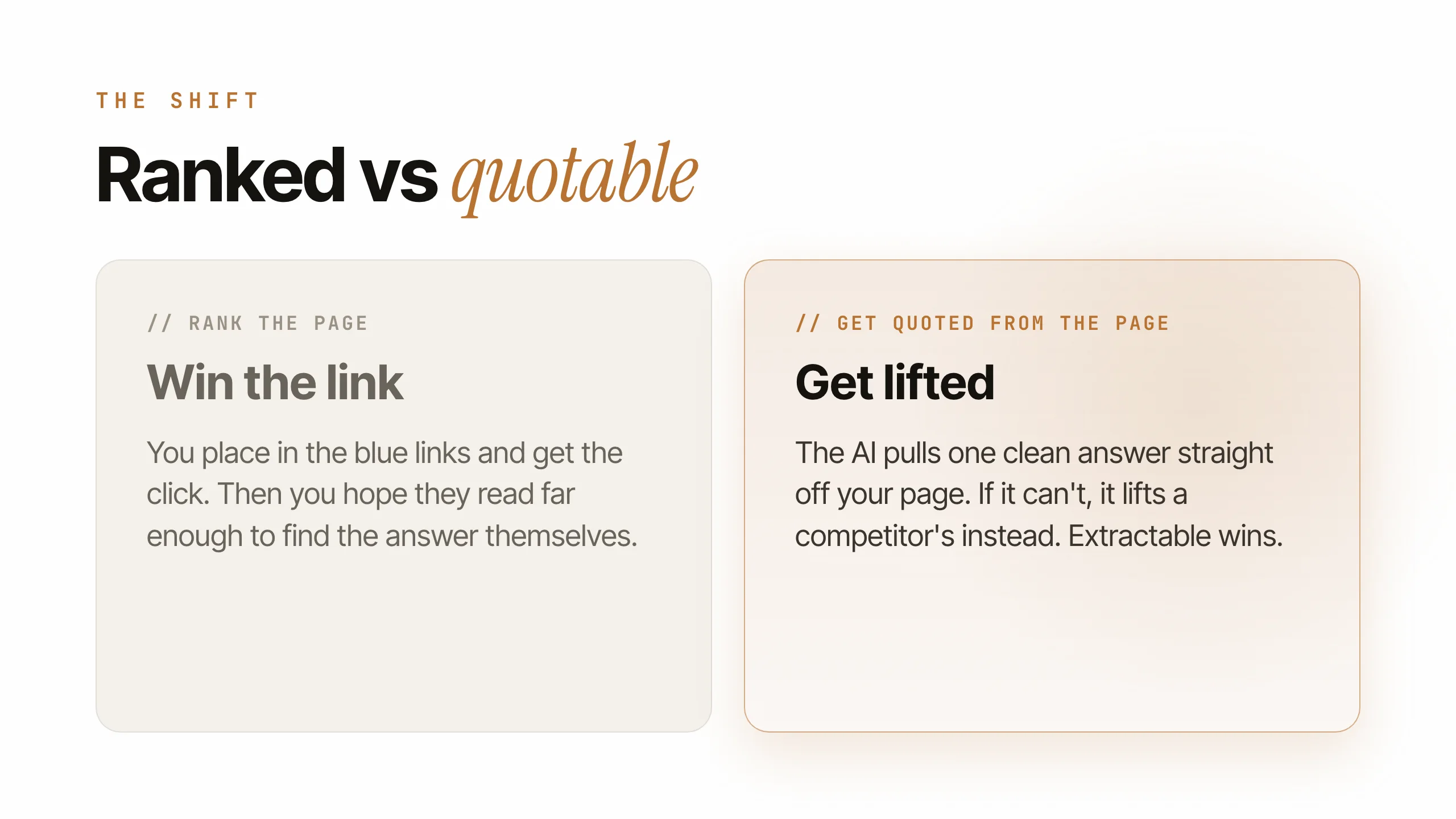
Rank the page
The old game
- Win the blue link and get the click.
- Hope the reader scrolls far enough to find the answer.
- You are on the list, but nothing gets carried out.
Get quoted from the page
The new game
- The AI lifts one clean answer out of your page.
- If it cannot, it lifts a competitor's instead.
- Extractable wins. The clean answer is what gets carried out.
LLMs read for structure, not for vibes
Here is why clarity beats volume. Large language models are not reading your page for tone. They are hunting for structure: entities, steps, attributes, comparisons, caveats, and clear source signals (Search Engine Land, 2026). A clean H2 that says How much does it cost with the number right under it is a gift to the machine. A heading that says Unpacking the true value proposition is a wall.
Semrush frames the off-site version of this as five gap types: you can have a mention gap, a prompt gap, a source gap, a citation gap, or a narrative gap (Semrush research, 2026). The one nobody talks about is the on-page one behind all of them. If the AI cannot extract a clean answer from your page, every one of those downstream gaps gets worse, because there is nothing quotable to cite in the first place.
The blogger's version of the rule, from Search Engine Land, is blunt and I love it: write for toddlers, drunk adults, and LLMs (Search Engine Land, 2026). All three want the answer up front, in plain words, with no maze to walk through first.
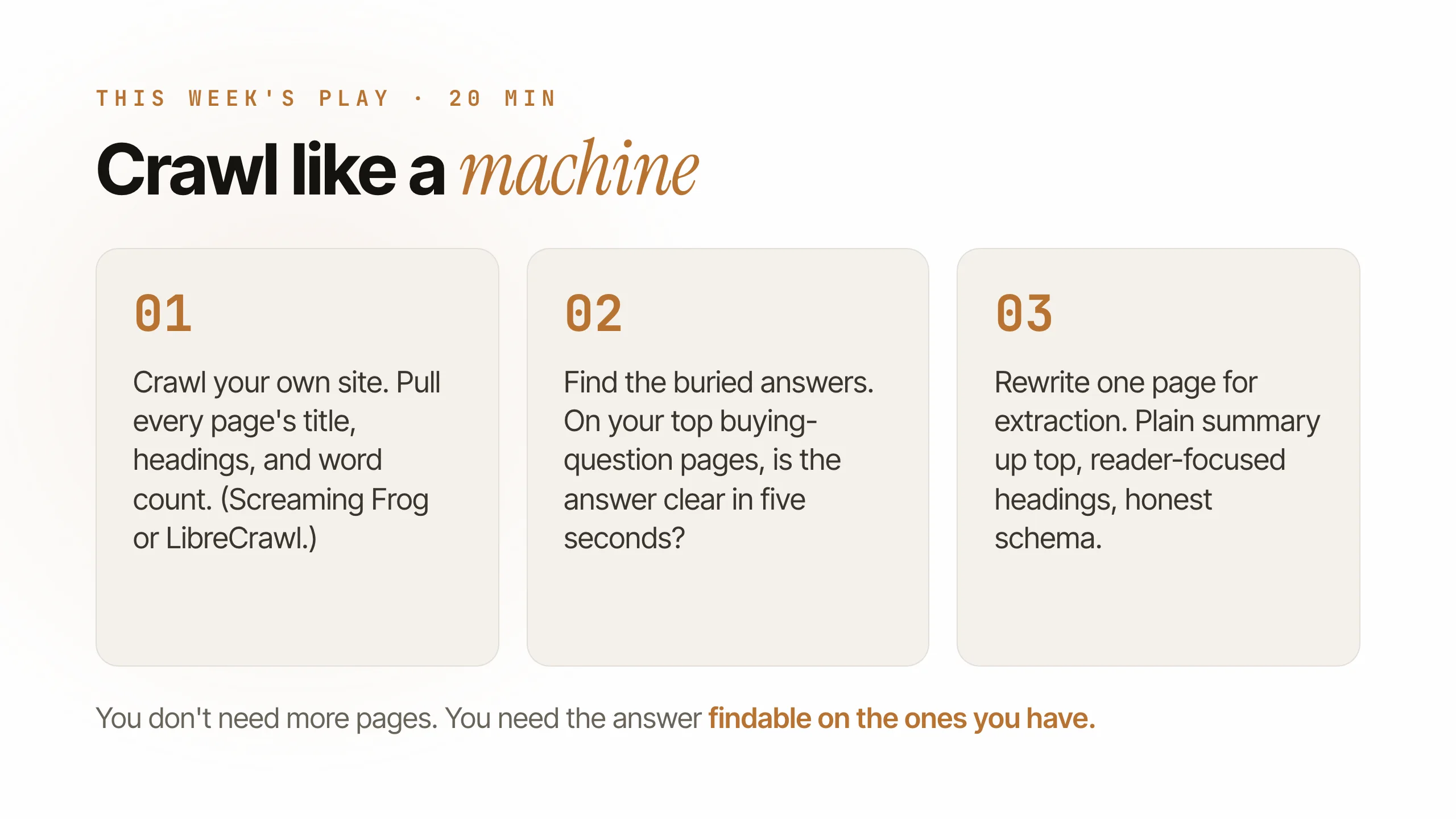
This week's play (20 min)
Three steps, one page fixed by the end.
One. Crawl your own site like a machine. Point a crawler at your domain and pull every page's title, headings, and word count in one view. The standard tool is Screaming Frog, free up to 500 URLs. I am testing the open-source route this week: LibreCrawl, an MIT-licensed crawler with no URL cap, JavaScript rendering, and you can self-host and modify it (github.com/PhialsBasement/LibreCrawl).
Two. Find the buried answers. Sort by your top five buying-question pages. On each one, ask a cold question: if a stranger scanned this in five seconds, would they get the answer. Look for the tells: vague headings, the answer sitting below a 300-word intro, a fake FAQ that answers nothing, a title written for a keyword tool instead of a human.
Three. Rewrite one page for extraction. Pick your single most important page and fix it: a plain-language summary up top, reader-focused H2s like Why this works, What it costs, and Mistakes to avoid, descriptive link text instead of click here, and schema that matches what is actually visible on the page (Search Engine Land, 2026). One page, done properly, beats ten pages skimmed.
The tooling note behind this: Screaming Frog is the default and it is genuinely good. But I keep reaching for open source when a tool only rents me synthesis I could own. LibreCrawl being MIT-licensed means I can read exactly how it crawls and bend it to test the extraction questions I care about. And we pull our SERP and citation data through DataForSEO, a pay-as-you-go API, not a $100-a-month seat. Crawl on the desktop, enrich with the API, own the workflow. That is the whole stack.
One prompt to run
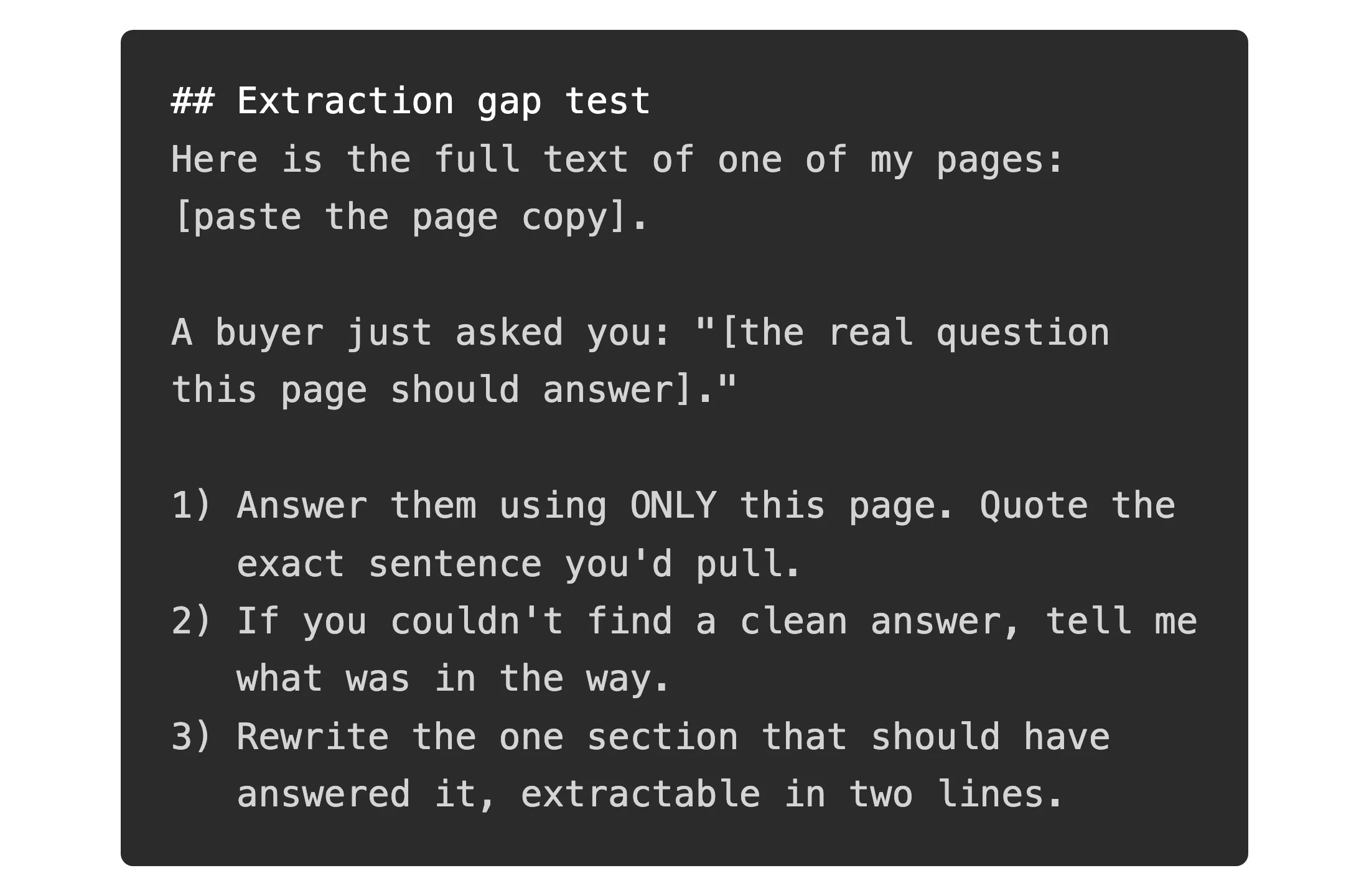
Paste one of your pages into this prompt in ChatGPT or Claude. It forces the AI to try to answer a real buyer question using only that page, tell you what got in the way if it cannot, and rewrite the section that should have answered it.
Extraction gap test. Here is the full text of one of my pages: paste the page copy. A buyer just asked you: the real question this page should answer. First, answer them using only this page, and quote the exact sentence you would pull. Second, if you could not find a clean answer, tell me what was in the way: buried, vague heading, no direct statement, and so on. Third, rewrite the one section that should have answered it, so the answer is extractable in the first two lines.
If the AI struggles to quote you from your own page, so will every AI answer that visits it. You do not need more pages. You need the answer to be findable on the ones you have. Crawl your site the way a machine does, and fix the first page where it gets stuck.
Around the search
The AI traffic map is redrawing fast. ChatGPT's share of gen-AI web visits slid from roughly 76% in mid-2025 to about 52% a year later as Gemini and Claude climbed (Similarweb, 2026). Optimizing for one assistant is now a bet. Structure that any of them can read is the hedge.
Ads have arrived inside the answer. Ads showed up in 26% of US desktop ChatGPT chats in June 2026 (Similarweb, via PPC Land, 2026). The free real estate of an unpaid AI mention is going to get more crowded, not less. Another reason to lock in the earned, extractable version now.
And the reminder from the clarity beat: Search Engine Land's whole 2026 update for bloggers boils down to one line, clarity is your SEO strategy (Search Engine Land, 2026). Not word count. Not publish-date flipping. Clarity.
FAQs
Questions this resource answers
What is the extraction gap?
+
The extraction gap is the distance between the AI landing on your page and the AI actually using your page. Even when an AI reaches your site, it can only quote you if it can pull one clean, direct answer out of the page. If your answer is buried under a long intro, vague headings, or ad breaks, the AI gives up and quotes a clearer competitor page instead.
How do I crawl my own site the way an AI reads it?
+
Point a crawler at your domain and pull every page's title, headings, and word count in one view. Screaming Frog is the standard and is free up to 500 URLs. LibreCrawl is an open-source, MIT-licensed alternative with no URL cap and JavaScript rendering that you can self-host and modify. Then sort by your top buying-question pages and check whether a stranger could find the answer in five seconds.
Can a page rank well and still not get cited by AI?
+
Yes. Ranking in the blue links and being quotable by AI are two different things. LLMs read for structure, not tone, so a page can hold the top spot and still be too messy for a model to lift a clean answer out of. You can win the ranking and still lose the citation.
Why does AI referral traffic matter now?
+
Because it converts and it pays. Gen-AI platforms averaged 9.5 billion visits a month over the last year, up 70% (Similarweb, 2026), those referrals convert on transactional sites at around 7% (Similarweb, 2025), and the average AI search visitor is worth 4.4 times the average organic one (Semrush research, 2025). Most brands have never audited that channel from the machine's side.
Free kit
The extraction gap is the on-page half. Run the off-site half in about two minutes: the free AI Search Audit scores how findable and citable you are across ChatGPT, Perplexity, Google AI, and Claude, and shows the first thing to fix. Run the free audit→
One useful AI tool a week
Short notes. Practical systems. No daily emails.