The short version
Three things get you cited by AI search engines in 2026: answer-first content the model can lift in one clean block, entity clarity so it can verify who you are, and source trust from third-party mentions, original data, and fresh publishing. Princeton research found quotations, statistics, and citations each lift AI visibility 25 to 40%. The brands that win are simply the easiest to quote and verify.
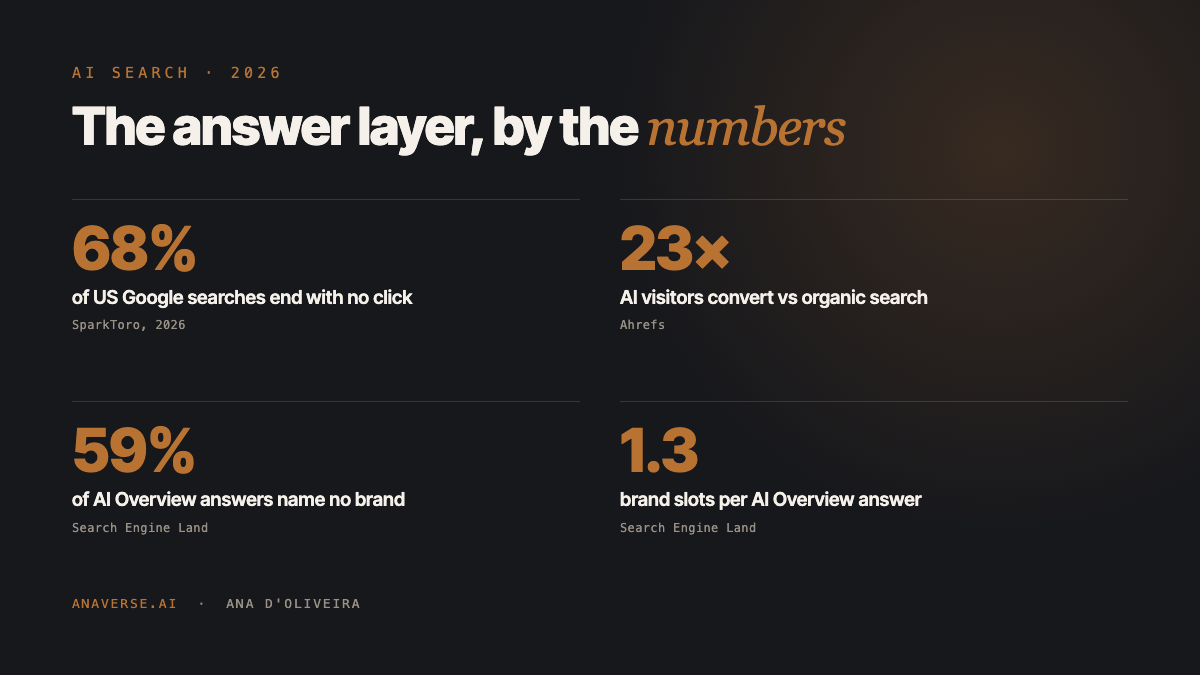
- AI answers have very few brand slots and most sit empty: Google AI Overviews average about 1.3 brand mentions per response, and roughly 59% name no brand at all [4]
- AI referral traffic is tiny but converts far above organic: Ahrefs saw 0.5% of visits drive 12.1% of signups, about 23 times organic [3]
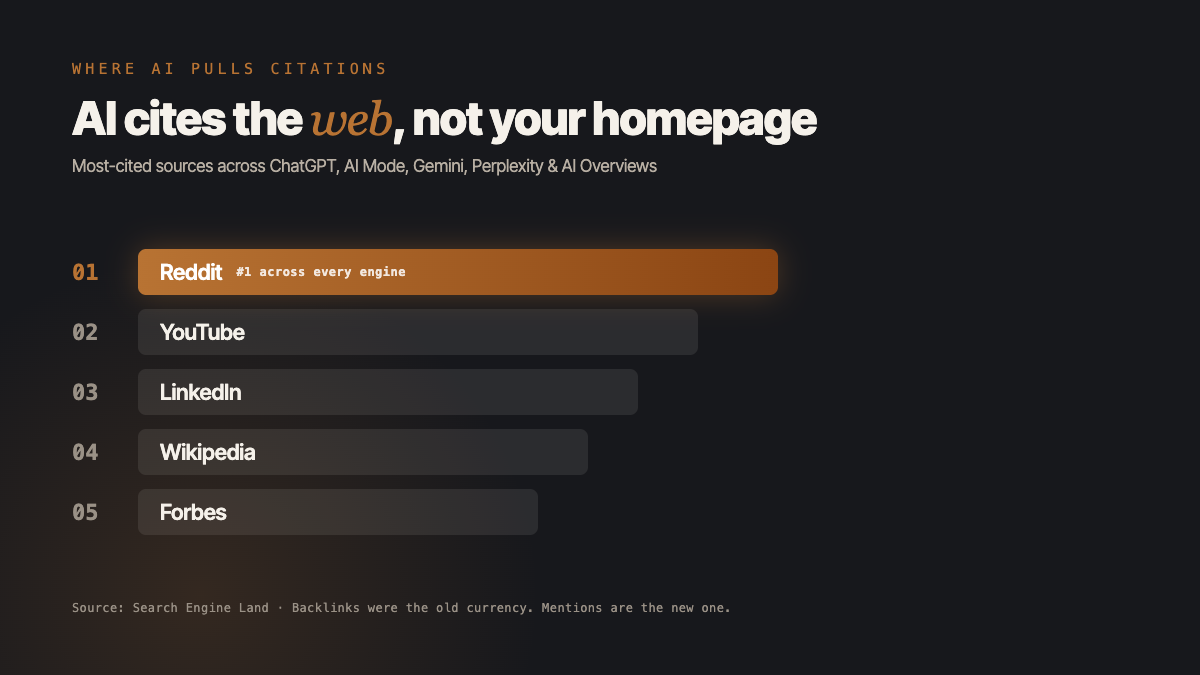
- Most citations point at third parties, not your site: Reddit is the most-cited source across every engine, with YouTube, LinkedIn, Wikipedia, and Forbes next [6]
- A citation is not a recommendation: AI Overviews cite a brand's own listicle, then recommend a competitor about 69% of the time [7]
- No special schema is required for Google's AI features: eligibility is being indexed, snippet-eligible, and genuinely helpful [10]
The data-backed 2026 playbook to get your brand cited by ChatGPT, Perplexity, and Google AI Mode: real citation benchmarks, the 3 rules that work, a ranked build order, and a 30-day sequence. The goal is not to chase every AI tool. The goal is to build a useful marketing system that a real team can understand, repeat, and improve.
Why does getting cited beat ranking in 2026?
Your buyers stopped searching. They started asking. When they ask an AI which product to buy, they get one synthesized answer that names one or two brands, not ten blue links. If your brand isn't in that answer, you're invisible at the moment the decision gets made.
Here is the fastest way to see where you stand. Open ChatGPT or Perplexity and ask 'what are the best tools in my category for my ideal customer?' If your brand isn't named, that's your biggest growth gap this year. Screenshot it. That's your baseline.
The click you spent a decade chasing is disappearing. SparkToro's 2026 clickstream analysis found fewer than one in three Google searches now ends in a click to the open web, with about 68% producing no click at all in early 2026 [1]. When a Google AI Overview appears, a field study covered by Search Engine Journal found it cut organic clicks by about 38%, pushing zero-click on those queries from 54% to 72% [2].
Ranking number one on a page nobody clicks is a trophy for a game that already ended. But the clicks that survive convert harder. Ahrefs looked at its own traffic and found AI search was about 0.5% of visits yet drove 12.1% of signups, roughly 23 times the conversion rate of organic, and Buffer reported AI conversions 185% higher than organic [3]. The honest caveat: it depends on your business model, and Ahrefs found AI referrals can convert worse for some ecommerce sites, so measure your own. SEO gets you the click. AEO gets you quoted.
What do the 2026 AI citation benchmarks look like?
Two things define the opportunity: there are very few brand slots per answer, and most sit empty. Search Engine Land's citation research found Google AI Overviews average only about 1.3 entity mentions per response, and roughly 59% name no brand or person at all [4]. There's no crowded auction for these slots yet. Most of your category hasn't shown up.
The engines behave very differently. Semrush's AI Visibility Index, built on 126 million US prompts, found ChatGPT cites around 15 sources per response while Gemini cites around 3 [5]. More sources cited, more chances to be one of them.
And a trap worth naming: a citation isn't a recommendation. Search Engine Land found AI Overviews will cite a brand's own 'best tools' listicle, then recommend a competitor about 69% of the time [7]. The fix isn't to stop making 'best of' content. It's to stop writing the neutral roundup that hands the win to a competitor. Write the opinionated, data-backed version where your answer is the obvious conclusion.
The one thing AI can't do: swap out your name
Everything here wins category questions like 'what's the best CRM for a small team?' Those are exactly where AI can quietly hand your lead to a competitor.
Brand questions are different. When someone types your actual name, the AI has to talk about you. It can't answer 'is this brand any good?' with someone else's product.
So the strongest spot isn't just ranking for the category. It's getting enough people to ask for you by name that the category question stops deciding the sale. Category work gets you found. Real reputation, reviews, and word of mouth get people asking for you directly, and that's the part no competitor can take.
Where do AI engines pull their citations from?
Mostly not your website. That's the most important thing to understand about AEO. Across ChatGPT, AI Mode, Gemini, Perplexity, and AI Overviews, Reddit is the single most-cited source, with YouTube, LinkedIn, Wikipedia, and Forbes filling out the top five [6]. In Google AI summaries, Wikipedia, YouTube, and Reddit together account for roughly 15% of all links, and government sources make up about 6% versus 2% in standard results [6].
Backlinks were the currency of SEO. Mentions are the currency of AEO. Semrush's ghost citations study makes the gap concrete: about 62% of AI citations never turn into a brand mention at all [8]. Your site is where you control the answer. The rest of the web is where the AI decides whether to trust it.
- Get present where your engine pulls from. Buyers on Perplexity need a real Reddit and fresh-content presence. Broad consumer buyers on ChatGPT and AI Overviews need Wikipedia-grade entity signals and YouTube coverage.
- Freshness is a factor. Recency shows up repeatedly in AI citation studies, so a real publishing cadence matters.
- Third-party trust isn't a nice-to-have. It's most of the game.
Rule 1: Publish answer-first content an AI can extract
Google's own 2026 guidance is plain: no magic markup, no dark art. Be eligible for Search and publish helpful, people-first content [10]. On top of that baseline, three moves separate cited brands from invisible ones. This is the first.
Put the answer at the top of the section, then build the page around real questions. AI systems retrieve and quote self-contained answers. They can't lift a paragraph that opens with 'in this article, we'll explore.' The Princeton GEO paper ran thousands of queries and found that adding quotations, statistics, and citations each raised a page's visibility in AI answers by roughly 25 to 40% [9]. Format tracks intent too: 'best' queries pull from listicles and tables, 'how-to' queries pull from step-by-step guides.
- Lead each section with a direct, self-contained answer.
- Make headings the literal question a user asks.
- Add a short summary the model can quote whole.
- Back claims with a cited number, a quote, or original data.
Rule 2: Make your entity clear so the AI knows who you are
An AI won't confidently name a brand it can't identify and verify. Entity clarity means describing your brand the same way everywhere and giving machines a way to connect the dots. Use the same name and one-line description across your site, LinkedIn, Crunchbase, and Wikidata, so the Knowledge Graph resolves you as one entity.
One note on schema, because the internet is full of bad advice here. Google's documentation says plainly that no special structured data is required to appear in AI Overviews or AI Mode [10]. Schema still helps with rich results and machine readability, but it's not a citation cheat code. Entity consistency across the web does more than any single block of markup.
Rule 3: Build source trust the AI can see
The pages that get cited are clear, current, consistent, and backed by other sources. Since most citations point at third parties, this is where the real leverage lives.
- Put things on your page an AI can't get elsewhere: original data, a real expert quote, a number you measured. SEOs call this information gain, and it's one of the strongest reasons a model quotes you over someone else.
- Earn mentions on sites your engine trusts: Reddit, YouTube, Wikipedia, industry roundups. One solid third-party mention beats fifty thin blog posts.
- Publish on a real cadence. Freshness reads as reliability.
Which AEO moves should you do first?
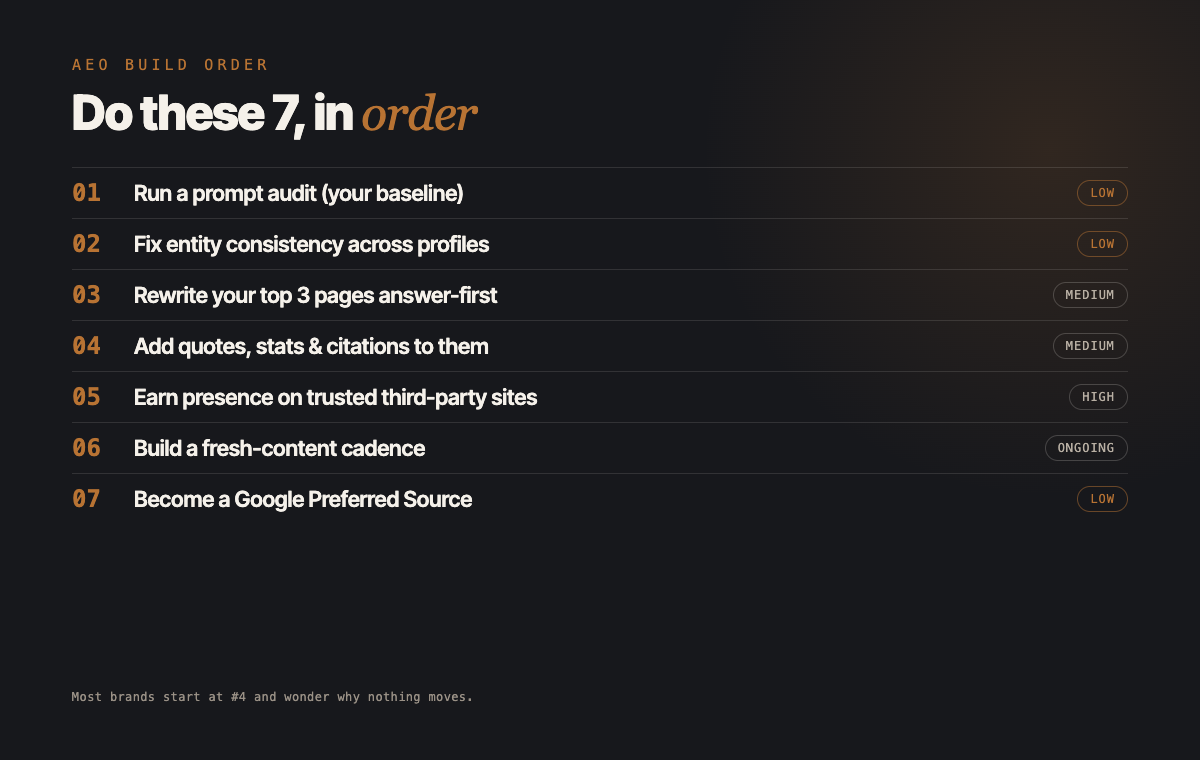
Not everything matters equally. Here is the build order, ranked by impact against effort. Most brands skip straight to writing more posts, which is number four of seven, and wonder why nothing moves.
One clarification on number seven, because it's widely misunderstood. There's no form to apply to become a Preferred Source. Eligibility is earned: Google has to recognize your domain as a real publisher first, through consistent organization signals, a genuine publishing cadence, and E-E-A-T. Once you're eligible, the doable part is easy and real. You add the opt-in link at google.com/preferences/source and ask your audience to pick you. You earn the eligibility, then you actively ask people to choose you. Both halves matter.
| # | Move | Why it ranks here | Effort |
|---|---|---|---|
| 1 | Run a prompt audit (baseline) | You can't improve what you haven't measured | Low |
| 2 | Fix entity consistency across profiles | Lets the model resolve and trust you as one entity | Low |
| 3 | Rewrite your top 3 pages answer-first | Directly lifts extraction on pages closest to cited | Medium |
| 4 | Add quotes, stats, and citations to those pages | About 25 to 40% visibility lift per element | Medium |
| 5 | Earn presence on trusted third-party platforms | Most citations point off-site; the core lever | High |
| 6 | Build a fresh-content cadence | Recency is a repeated citation signal | Ongoing |
| 7 | Add the Preferred Source opt-in and drive picks | A real button you add; only eligibility is earned | Low |
What's the 30-day AEO execution sequence?
A concrete, do-it-in-order plan for a solo operator or a small team.
- Day 1, baseline. Ask ChatGPT, Perplexity, and Google AI your 5 biggest buying questions. Screenshot which brands and sources appear. This is your before number.
- Day 2 to 4, entity fix. Standardize your name and one-line description across site, LinkedIn, Crunchbase, and Wikidata.
- Day 5 to 7, author and fundamentals. Real author bios and E-E-A-T signals. Confirm pages are indexable and snippet-eligible.
- Day 8 to 12, rewrite your top 3 pages answer-first, with question headings and a short summary.
- Day 13 to 16, add proof. A cited stat, an original data point, or an expert quote in each page.
- Day 17 to 22, earn presence. One useful Reddit or community answer, one guest mention, one roundup listing.
- Day 23 to 26, publish fresh. One new answer-first post on a real buyer question, dated this month.
- Day 27 to 29, opt-in and indexing. Add the Preferred Source link if eligible, and request indexing in Search Console.
- Day 30, re-audit. Re-run day one's prompts. The gap you closed is your proof and next month's roadmap.
How do you measure AI search visibility?
Start with the manual prompt audit. It works today, in any account. Ask your five buying questions across ChatGPT, Perplexity, and Google AI Mode, screenshot how you show up, and repeat monthly.
One honest caveat: AI answers are personalized by history, location, and session, so a manual audit gives you a directional baseline, not an absolute score. Run it logged out or in incognito to reduce the skew. To track this at scale, an AI-visibility tool like Semrush's AI Visibility Index samples across thousands of prompts and regions [5].
On the platform side, Google started adding AI Overviews and AI Mode reporting to Search Console in 2026, but it's rolling out to a limited set of sites first, so most accounts can't see it yet. Because zero-click AI answers often generate no referral session, GEO is harder to measure than SEO. That's exactly why the manual audit is the method here, not a fallback.
Sources
Every stat above maps to a named study or to Google's own documentation.
- [1] SparkToro, 2026 zero-click clickstream study (sparktoro.com)
- [2] Search Engine Journal, AI Overviews field study on organic clicks (searchenginejournal.com)
- [3] Ahrefs, AI search traffic conversion and AI traffic growth studies (ahrefs.com)
- [4] Search Engine Land, insights from 8,000 AI citations (searchengineland.com)
- [5] Semrush AI Visibility Index, 126 million prompts (semrush.com)
- [6] Search Engine Land, most-cited AI sources study (searchengineland.com)
- [7] Search Engine Land, AI Overviews and self-serving listicles (searchengineland.com)
- [8] Semrush, ghost citations study (semrush.com)
- [9] Princeton GEO paper, Aggarwal et al., KDD 2024 (arxiv.org/abs/2311.09735)
- [10] Google Search Central, AI features documentation (developers.google.com)
FAQs
Questions this resource answers
What is the difference between AEO and GEO?
+
AEO (Answer Engine Optimization) focuses on getting your content extracted as a direct answer in AI interfaces. GEO (Generative Engine Optimization) is broader, influencing what generative systems say and cite across discovery. You optimize for both with the same practices: answer-first content, entity clarity, and source trust.
Do I need special schema to get into AI Overviews?
+
No. Google's documentation says there's no special structured data required to appear in AI Overviews or AI Mode. Schema still helps with rich results and machine readability, but eligibility comes from being indexed, snippet-eligible, and genuinely helpful.
Does SEO still matter in 2026?
+
Yes. Google frames generative-search readiness as part of SEO, not a replacement. Clean architecture, quality content, and trust signals help you both rank and get cited.
Which AI engine should I optimize for first?
+
The one your buyers use. Reddit, YouTube, and Wikipedia recur as top sources across engines, so presence there is rarely wasted. Beyond that, follow your audience.
How long does AEO take to work?
+
Entity and content fixes can be picked up within weeks. Third-party trust and citation signals compound over months. The prompt audit gives you an immediate baseline so you can see movement early instead of guessing.
Free kit
Getting cited starts with a site an AI can actually read, parse, and trust. The Agent-Ready Website Kit is the checklist I use to make a site machine-readable before any of this compounds. Agent-Ready Website Kit→
One useful AI tool a week
Short notes. Practical systems. No daily emails.