The short version
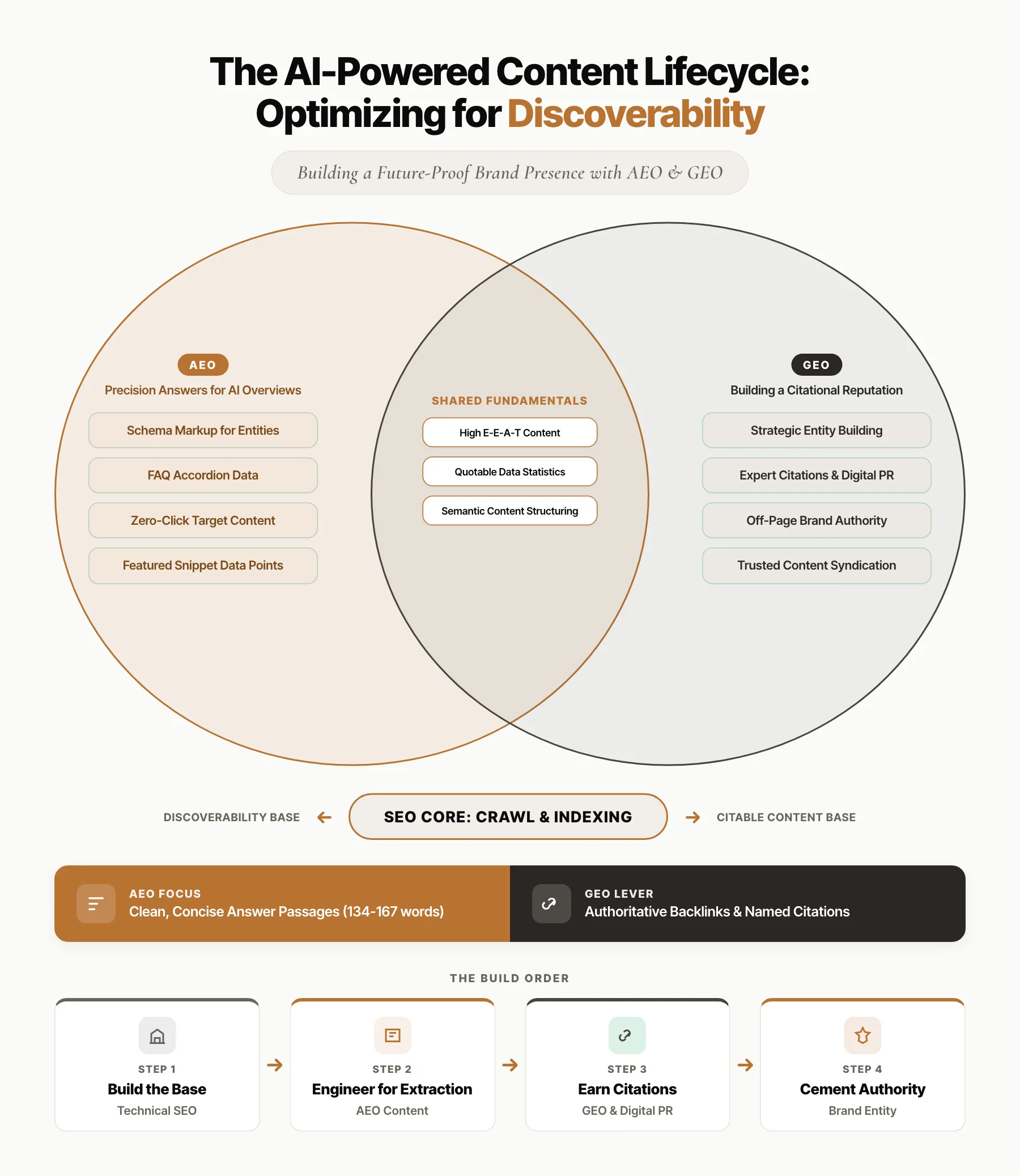
SEO, AEO, and GEO are three ways to be found, and each one targets a different surface. SEO optimizes to rank in Google's list of blue links. AEO (answer engine optimization) optimizes to win the structured answers an engine extracts and quotes directly, like featured snippets, voice results, and fact boxes. GEO (generative engine optimization) optimizes to be named and cited inside answers that AI generates, from Google's Gemini-powered AI Overviews to ChatGPT, Perplexity, and Claude. The clean line is extraction versus synthesis. You do not choose one. They stack on the same content, and in 2026 SEO is still the foundation the other two build on.
- The clean line: AEO wins the extracted snippet, GEO wins the AI-generated answer.
- AI Overviews are GEO, not AEO. They are synthesized by Gemini, they sit on Google's results page.
- They stack on one piece of content. You do not pick one, you layer all three.
- GEO's main lever is brand mentions, which one 2025 study tied to AI citations far more than backlinks.
- Gartner expects traditional search volume to drop 25% by 2026, so AEO and GEO are now table stakes.
SEO ranks you on Google. AEO gets you into AI answers. GEO gets you cited by ChatGPT and Gemini. Here is the difference, and which one to focus on in 2026. The goal is not to chase every AI tool. The goal is to build a useful marketing system that a real team can understand, repeat, and improve.
What is the difference between SEO, AEO, and GEO?
SEO, AEO, and GEO all help people find you, but each one aims at a different spot. SEO, or search engine optimization, is the work of ranking in Google's list of blue links: keywords, links, and a fast, crawlable page. AEO, or answer engine optimization, aims one step higher on the page. Instead of a link in the list, you want to be the structured answer an engine extracts and quotes directly, such as a featured snippet, a People Also Ask box, or a voice result. GEO, or generative engine optimization, targets the answers AI generates rather than extracts. That includes standalone assistants like ChatGPT, Perplexity, and Claude, and it also includes Google's AI Overviews, which are synthesized by Gemini and sit on top of the results page. The clean line is extraction versus synthesis: AEO wins the pulled-out fact, GEO wins the generated paragraph. Same goal of being found, three different targets: a ranking position, an extracted answer, and a cited mention.
| SEO | AEO | GEO | |
|---|---|---|---|
| Goal | Rank in the blue-link list | Be the extracted answer | Be cited in AI-generated answers |
| Where you show up | Google results page | Featured snippets, voice, fact boxes | AI Overviews, ChatGPT, Gemini, Perplexity |
| Primary asset used | Webpages and articles | Dedicated Q&A blocks and schema | Brand footprint and sentiment across the web |
| Main lever | Keywords, links, page speed | Structured, question-led answers | Brand mentions, citations, entity trust |
| How you measure | Rankings, organic clicks | Snippet and answer-box share | Citation rate, share of voice |
What is answer engine optimization (AEO)?
Answer engine optimization is structuring your content so an engine can lift a clean, complete answer straight off your page and show it to the reader. The surfaces are extractive: a featured snippet, a People Also Ask box, a voice assistant result, or a direct fact box. The engine quotes your exact words instead of rewriting them, so the win is being the source it pulls from. The unit that wins at AEO is the self-contained answer block: a real question as your heading, then a tight answer right underneath that still makes sense if an engine quotes it on its own. Practically, that means you answer 'what is a good email open rate?' in one clean paragraph, instead of burying it inside a 2,000 word guide. Keep the answer specific, factual, and easy to extract, and you become the passage the engine reaches for.
Length matters more than people expect. Analyses of AI-cited passages put the sweet spot at roughly 134 to 167 words, long enough to fully answer and short enough to quote whole. That is the band every answer block in this article uses.
What is generative engine optimization (GEO)?
Generative engine optimization is the work of getting your brand named and cited inside answers that AI generates, rather than extracts. That includes standalone assistants like ChatGPT, Perplexity, and Claude, and it also includes Google's AI Overviews, which are synthesized by Gemini and sit at the top of the results page. The difference from AEO is extraction versus synthesis. AEO wins when an engine quotes your exact words; GEO wins when a model writes its own paragraph and decides to mention you in it. The lever is reputation rather than ranking. These models lean on how your brand appears across the open web they trained on and retrieve from, so how often, how clearly, and how favorably you are mentioned matters more than any single page. In plain terms, SEO is about your pages, and GEO is about your presence everywhere else.
The research backs this up. A 2024 Princeton, Georgia Tech, and IIT Delhi study, presented at ACM KDD 2024, found that GEO methods like adding citations, quotations, and statistics lifted a source's visibility in generative answers by up to 40%. And a 2025 Ahrefs analysis of 75,000 brands found that brand mentions correlate with AI citations far more strongly than backlinks do, with YouTube and Reddit mentions carrying outsized weight.
AEO vs SEO vs GEO: which one should you focus on in 2026?
You do not pick one, because they feed each other, but the order matters when your time is limited. SEO is still the foundation. Rand Fishkin's March 2026 analysis of the 5,000 most-visited sites found Google still carries about 73% of search traffic, so a site that cannot rank or be crawled cannot be cited either. AEO is the highest-leverage next layer, because the featured snippets and answer boxes it wins sit directly on top of the rankings your SEO already earns. GEO is the long game: it compounds slowly through mentions and reputation, and it now decides whether you show up inside AI Overviews and assistant answers, which you cannot shortcut with a single page. The honest answer for most brands is to do SEO and AEO on the same content now, and start the GEO groundwork, getting mentioned and cited, in parallel.
The good news is the three reward the same underlying signals. According to Lily Ray, VP of SEO Strategy and Research at Amsive, the sites gaining share in AI Overviews are the ones that already score highest on Google's E-E-A-T signals: real authors, transparent expertise, and first-hand experience. Build that, and you are optimizing for all three at once.
- New site, little authority: lead with SEO and AEO. You cannot be cited if you cannot be found.
- Established site, flat AI visibility: invest in GEO. Earn mentions on YouTube, Reddit, and trusted publishers.
- Local or product brand: AEO first, since buyers ask AI assistants direct, comparison-style questions.
How do you optimize for SEO, AEO, and GEO at the same time?
The most useful thing to know is that you do not run three separate playbooks. One well-built page can serve all three, because they reward overlapping signals: clear structure, trustworthy authorship, and quotable, factual answers. The trick is to write the page so it ranks (SEO), so each section answers one question cleanly enough to be extracted (AEO), and so it earns mentions and cites real sources that make models trust it (GEO). Add the technical layer that lets AI read you at all, then go earn the off-page mentions that GEO runs on. Do those together and you stop choosing between today's Google and tomorrow's AI answers.
- Write question-led headings with a self-contained 120 to 170 word answer under each.
- Cite real, dated statistics and name credible sources. Models and readers both trust attribution.
- Add stacked schema (Article, FAQPage, Organization) so engines can parse your entity.
- Show real authorship and expertise on the page to satisfy E-E-A-T.
- Earn brand mentions off-site, especially YouTube and Reddit, since those drive GEO citations.
- Check your robots.txt is not blocking AI crawlers like GPTBot, PerplexityBot, and Google-Extended, or you opt out of GEO by accident.
FAQs
Questions this resource answers
Is GEO the same as AEO?
+
They overlap but are not identical. AEO (answer engine optimization) wins extractive surfaces, where an engine quotes your exact words: featured snippets, People Also Ask, and voice results. GEO (generative engine optimization) wins synthesized answers, where a model writes its own response and decides to cite you: ChatGPT, Perplexity, and Google's Gemini-powered AI Overviews. The clean line is extraction versus synthesis.
Does SEO still matter in 2026?
+
Yes. Rand Fishkin's 2026 analysis found Google still carries about 73% of search traffic, and AI Overviews are built on top of the pages that already rank. A site that cannot be found or crawled cannot be extracted or cited either, so SEO remains the foundation the other two build on.
Which is more important, AEO or GEO?
+
For most brands, AEO pays off faster because it builds directly on the rankings you already have. GEO is the slower, compounding game that runs on reputation and mentions across the web. Start AEO now, and begin the GEO groundwork in parallel rather than waiting.
How is GEO different from SEO?
+
SEO is about your own pages: ranking them with keywords, links, and technical health. GEO is about your presence everywhere else, meaning how often and how clearly your brand is mentioned and cited across the web that AI models train on and retrieve from. SEO optimizes a page; GEO optimizes a reputation.
Can one piece of content do SEO, AEO, and GEO at once?
+
Yes, and that is the efficient approach. The three reward overlapping signals: clear structure, trustworthy authorship, quotable answers, and cited sources. Write a page that ranks, answers each question in an extractable block, and earns mentions, and it serves all three at the same time.
How do you measure GEO?
+
You track citation rate, how often AI assistants name your brand, and share of voice against competitors for the same prompts. Tools that run prompts across ChatGPT, Perplexity, Gemini, and Google AI Overviews on a schedule give you a directional baseline, since the AI vendors offer no native dashboard.
Is answer engine optimization replacing SEO?
+
No, it is layering on top of it. Gartner expects traditional search volume to drop 25% by 2026 as people ask AI assistants directly, but search is not disappearing. The shift is that ranking alone is no longer enough, so AEO and GEO have become new requirements alongside SEO.
Is AI Overview AEO or GEO?
+
Google's AI Overview sits under GEO, since GEO covers being cited inside generative results across engines. AEO is the narrower craft of writing the clean, direct answer the Overview lifts. In practice they overlap: the answer block that wins an AI Overview is the same one AEO tells you to write.
Is GEO replacing SEO?
+
No. GEO sits on top of SEO. AI engines still lean on strong search signals to decide who is credible enough to cite. So SEO earns the trust, and GEO turns that trust into a citation inside the AI answer. You need both working together.
What is AIO, and how does it fit with SEO, AEO, and GEO?
+
AIO usually means AI Optimization, a catch-all for making content work across AI search. Think of it as the umbrella. SEO earns rankings, AEO writes the answer AI quotes, and GEO gets your brand cited inside generative results. AIO is just the label for doing all three together.
Free kit
The checklist and snippets to make your site readable, extractable, and citable by AI engines. It is the technical groundwork SEO, AEO, and GEO all sit on, and it takes about 15 minutes to set up. Get the free kit→
One useful AI tool a week
Short notes. Practical systems. No daily emails.