The short version
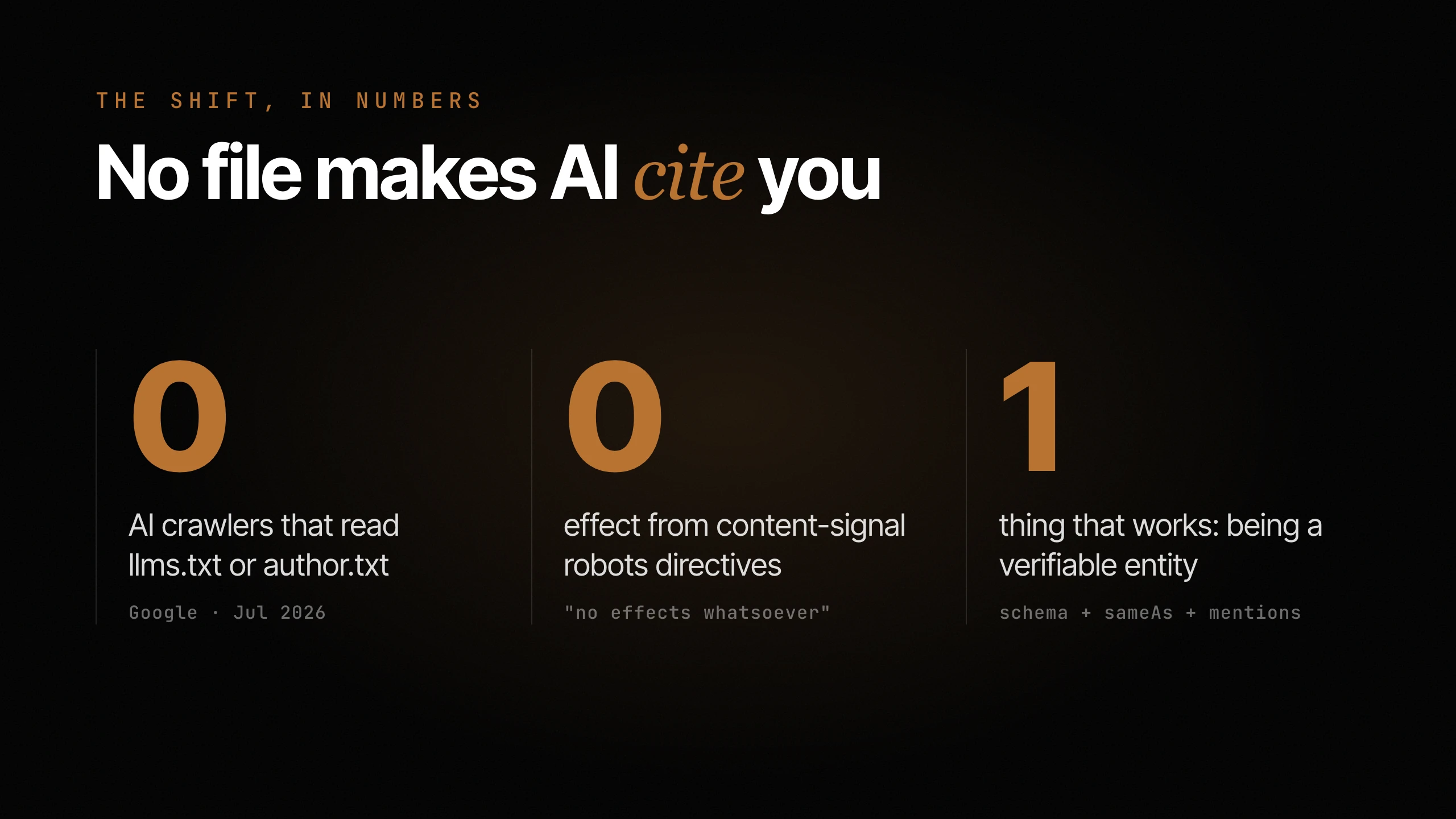
No file makes AI cite you. On July 6, 2026, Google's John Mueller confirmed Google does not use llms.txt or author.txt, and that the content-signal robots directive has no effect on any crawler or LLM. The thing that actually gets your brand named by AI is being a verifiable entity: a brand a model can confirm is real and consistent across the web. You build that with Organization schema on your homepage, a sameAs list linking every profile you own, one identical name and logo everywhere, and real mentions on pages you do not control. A file you wrote about yourself proves nothing. A footprint the web agrees on proves you exist, and that is what an AI checks before it names you in an answer.
- Stop adding llms.txt, author.txt, or content-signal to your site. Google confirmed no crawler or LLM reads them.
- AI cites entities it can verify, not files you wrote about yourself. Being a recognizable brand across the web is the real lever.
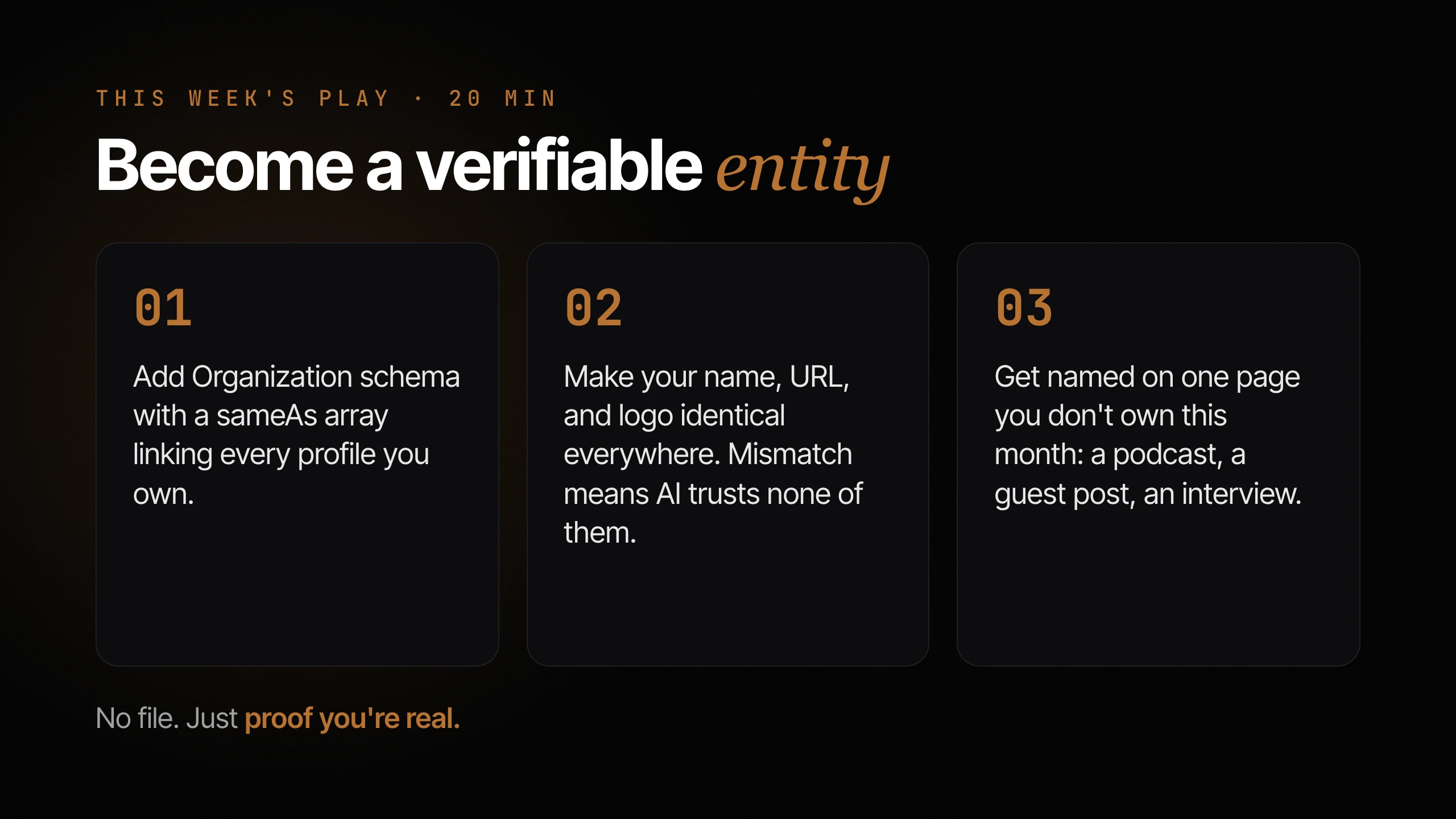
- Add Organization schema to your homepage with a sameAs array linking every profile you own.
- Make your name, URL, and logo identical everywhere. A mismatch tells a model you might be two different companies.
- Get named on one page you do not own this month. Mentions on trusted sites are what AI checks you against.
Google confirmed llms.txt, author.txt, and content-signal do nothing for AI. Here is what actually gets your brand named by AI search: becoming a verifiable entity. The goal is not to chase every AI tool. The goal is to build a useful marketing system that a real team can understand, repeat, and improve.
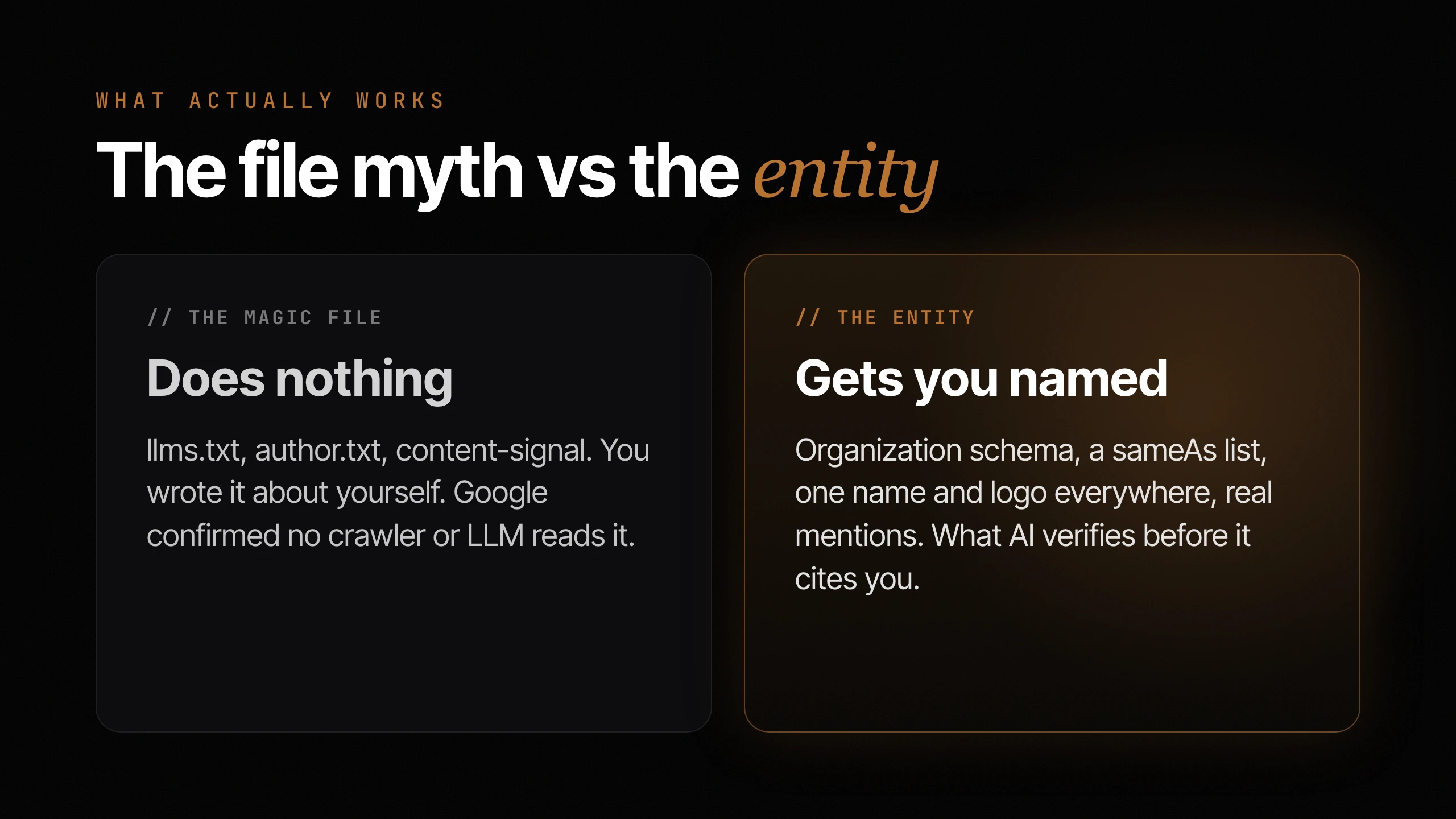
There is no magic file
Somewhere you read that if you drop an llms.txt or an author.txt file on your site, or add the new content-signal line to your robots file, AI tools will start citing you. So you added them, felt productive, and waited. Nothing happened, because the file was never the lever.
On July 6, 2026, Google's John Mueller answered this directly. He said Google does not use llms.txt or author.txt, and that he knows of no other crawler or LLM confirming they use them. On the content-signal directive he was blunter, saying it has no effect whatsoever for any crawler or LLM. The shortcut everyone is chasing is a placebo. While you edit text files, the thing that actually earns AI citations sits untouched.
The file myth versus the entity
SEO trained us to believe visibility is a config setting. Add the tag, flip the switch, get found. AI citation does not work like that. A model cites what it can confirm is a real, consistent thing across the web. You do not configure your way in. You prove your way in.
Here is the concrete version. Two companies sell the same thing. Company A spends the afternoon adding llms.txt and tweaking robots directives. Company B spends it adding clean Organization schema, linking its LinkedIn, Crunchbase, and YouTube in a sameAs list, and landing one podcast mention. Ask ChatGPT about the category next month, and it names Company B. Not because B found a trick, but because B is the only one the model can actually verify.
Why AI trusts entities, not files
An AI model will not stake an answer on a name it can only find in one place. It looks for the same brand, described the same way, across sources it already trusts: your site, your schema, your LinkedIn, a directory, a mention on a page you do not control.
That web of matching signals is what being an entity means. It is how the model tells you apart from the other companies with a similar name, and how it decides you are safe to name in an answer. A file you wrote about yourself proves nothing. A footprint the web agrees on proves you exist. That is the whole game.
The play this week: become a verifiable entity
You do not need a file. You need proof you are real. Pick your homepage and spend about twenty minutes on three things.
- Add Organization schema to your homepage with your name, url, logo, and a sameAs array that links every profile you own, from LinkedIn and Crunchbase to YouTube and your other socials. Google's own documentation says sameAs is how it disambiguates you from everyone else with your name.
- Make your name, URL, and logo identical everywhere. Same spelling, same domain, same mark on your site, your LinkedIn, and any directory. A mismatch tells a model you might be two different companies, so it trusts none of them.
- Get named on one page you do not own this month. A podcast, a guest post, one interview. Mentions on sites AI already trusts are what it checks you against.
One prompt to run today
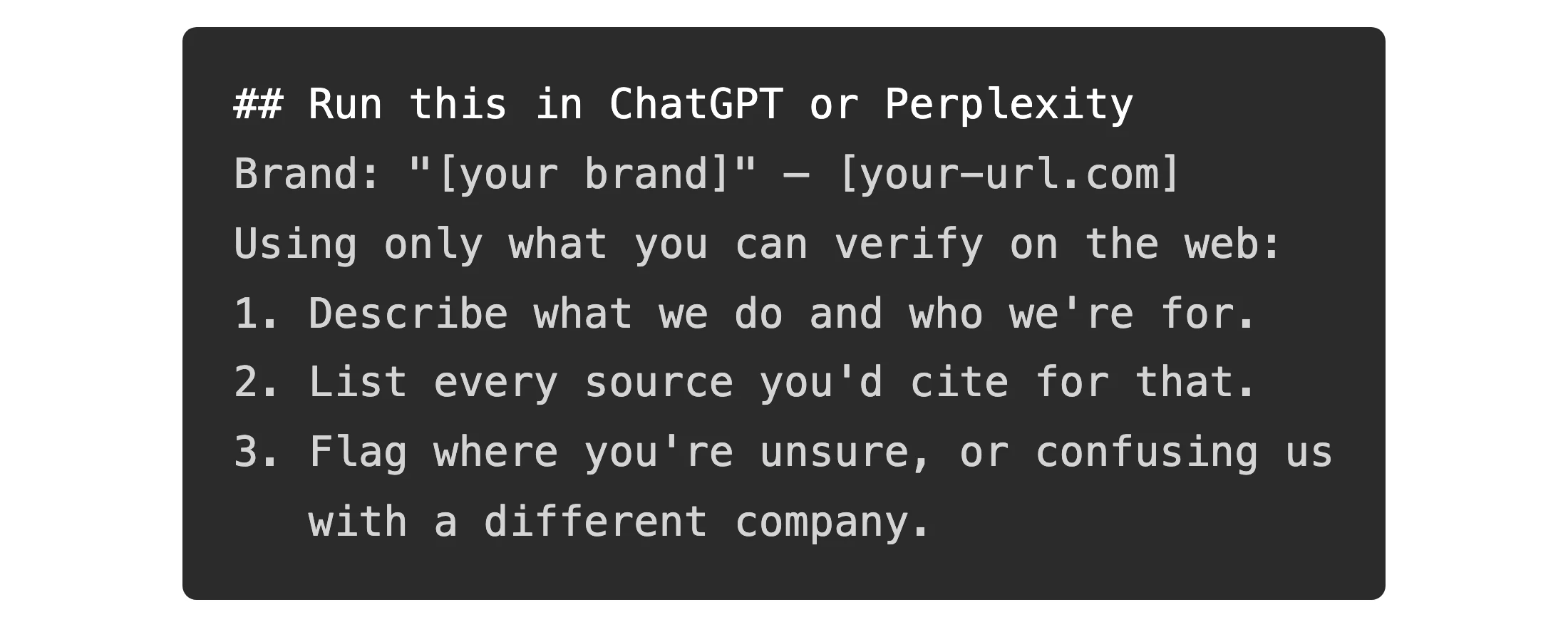
Stop guessing what AI can and cannot verify about you. Paste the prompt below into ChatGPT or Perplexity and swap in your brand and URL. It tells the model to describe what you do and who you are for, using only what it can verify on the web, list every source it would cite, and flag where it is unsure or confusing you with a different company.
If it cannot describe you, cannot cite a source, or mixes you up with someone else, that is not a content problem. It is an entity problem, and the three steps above are the fix.
FAQs
Questions this resource answers
Does Google use llms.txt or author.txt?
+
No. On July 6, 2026, Google's John Mueller confirmed Google does not use llms.txt or author.txt, and that he knows of no other crawler or LLM that uses them. Adding these files does not help your brand get cited by AI.
Does the content-signal robots directive affect AI crawlers?
+
No. Mueller stated the content-signal directive has no effect whatsoever for any crawler or LLM. It does not control whether AI tools use your content, so it will not change your AI search visibility.
What actually makes AI cite my brand?
+
Being a verifiable entity. AI models cite brands they can confirm are real and consistent across the web. Add Organization schema with a sameAs list, keep your name and logo identical everywhere, and earn mentions on pages you do not control. Those matching signals are what a model checks before it names you.
What is the sameAs property in Organization schema?
+
sameAs is a field in Organization structured data that links to your other official profiles, such as LinkedIn, Crunchbase, and YouTube. Google's documentation says sameAs helps it disambiguate your organization from others with a similar name, which is exactly the signal AI engines rely on to identify you.
Free kit
Run your domain through the free AI Search Audit. It scores how findable and citable you are across ChatGPT, Perplexity, Google AI, and Claude, and shows the first thing to fix. It takes about a minute. Run the free audit→
One useful AI tool a week
Short notes. Practical systems. No daily emails.