The short version
The June 2026 spam update is a global change to Google's spam-detection systems, released June 24, 2026 and completed two days later. Unlike a core update, which changes how Google ranks pages broadly, a spam update improves the automated systems, including SpamBrain, that find and demote content breaking Google's spam policies. The same thin, mass-produced content most exposed to it is also the content AI engines refuse to cite.
- Confirm the dates: the update ran June 24 to June 26, 2026, globally.
- Know the mechanism: spam updates sharpen SpamBrain, Google's spam-detection AI.
- Audit for scaled content abuse, the clearest target of this update.
- Cut or rewrite thin pages instead of making surface-level tweaks.
- Build genuine, citable depth, which protects rankings and earns AI citations.
- Expect slow recovery: Google says reassessment can take months.
Google's June 2026 spam update is done. Here is what it targets, why mass AI content is at risk, and how to protect your AI search visibility. The goal is not to chase every AI tool. The goal is to build a useful marketing system that a real team can understand, repeat, and improve.
What is the June 2026 spam update?
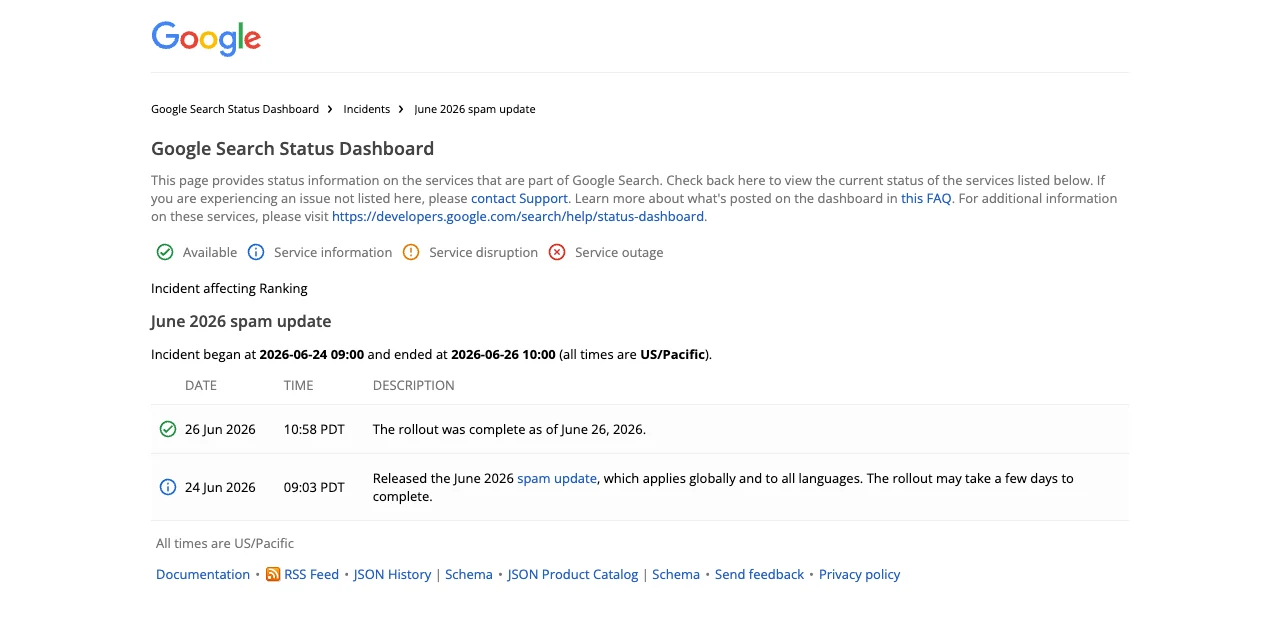
The June 2026 spam update is Google's latest refresh of the systems that detect and act on spam. Google announced the rollout on June 24, 2026 at 9:00 a.m. PT and confirmed it was complete on June 26. It applies globally and across all languages, so no region or market is exempt.
Spam updates exist to enforce Google's spam policies. When Google runs one, it retrains and tightens SpamBrain, its AI-based spam-detection system. Sites that have drifted into spammy patterns, knowingly or not, can lose rankings when the system gets better at spotting them. According to Google's own announcement, this was the second spam update of 2026, following one in March that finished in under a day. The takeaway: these are now frequent, fast, and worth understanding before the next one lands.
How is a spam update different from a core update?
A core update and a spam update solve different problems, and confusing them leads to the wrong fix. A core update is a broad change to Google's ranking systems. It re-weighs how all pages are assessed for relevance and quality, so a page can drop without doing anything wrong. A spam update is narrower: it upgrades the systems that detect violations of Google's spam policies, then demotes the pages that trip them.
That distinction decides your recovery plan. If a core update moved you, the answer is broad quality improvement over time. If a spam update moved you, you need to find and remove the specific spam pattern, then wait for reassessment. As Google describes it, spam updates improve automated systems that detect spam, including SpamBrain, while core updates are broad changes to ranking systems. Diagnose which one hit you before you touch anything.
| Spam update | Core update | |
|---|---|---|
| What it changes | Spam-detection systems (SpamBrain) | Broad ranking systems |
| Why you dropped | You tripped a spam policy | Broad quality re-assessment |
| The fix | Find and remove the spam pattern | Improve overall quality over time |
| Recovery speed | Can take months after the fix | Often next core update |
What does the June 2026 spam update target?
Google did not name a single target for this update, but the mechanism tells you where the risk sits. SpamBrain is trained to catch content that exists to game search rather than help a reader. The clearest pattern in that bucket right now is scaled content abuse: producing large volumes of low-value pages, often with AI, primarily to rank for keywords.
That is the practice most exposed by this update. Pointing a language model at a keyword list and publishing hundreds of near-identical posts a month is exactly the signature these systems are built to find. The tool is not the problem. AI-assisted content is fine when a human adds judgment, originality, and real value. The problem is volume with no value behind it. If your strategy has been publish more, faster, with no reason a human would read it, this update raises your risk.
Why does this matter for AI search visibility?
This is where a spam update stops being a Google-only story. The same signals that protect you from spam demotion are the signals that earn citations in AI answers. ChatGPT, Perplexity, Google AI Overviews, and Gemini all pull from sources that show genuine expertise, original information, and trust. Thin, mass-produced pages do not get cited, for the same reason they get demoted.
So a spam update is a preview of where all of search is heading. You cannot spam your way into Google rankings, and you cannot spam your way into AI answers either. Answer engine optimization and generative engine optimization reward depth, structure, and credibility. According to a 2025 Ahrefs study of roughly 75,000 brands, brand mentions correlated with AI citations far more strongly than backlinks, close to three to one. Earned reputation beats manufactured volume.
As Ana D'Oliveira, founder of Anaverse, puts it: a spam update is not Google punishing AI, it is Google getting better at telling the difference between content made to rank and content made to help. That line is the whole game now, in search and in AI answers.
What should you do if your traffic dropped?
If your rankings or traffic moved during the June 2026 spam update, resist the urge to make sweeping changes overnight. Start with diagnosis, then act on the specific issue. The same work that recovers a spam-hit site also builds AI search visibility, so it pays off twice.
- Confirm the timing: check your drop lines up with June 24 to 26 in Google Search Console, not an earlier core update.
- Review the spam policies: read Google's spam policy list and honestly audit your site against each one.
- Find the pattern, not one page: look for scaled low-value content, doorway pages, hidden text, or content made only for engines.
- Cut or rewrite, do not tweak: remove or genuinely upgrade thin pages, since surface edits will not reset the signal.
- Strengthen first-hand value: add original data, real examples, named expertise, and answers a reader would bookmark.
How long does recovery take after a spam update?
Recovery from a spam update is slow by design, and expecting a fast bounce-back leads to panic changes that make things worse. Google is explicit that even after you fix the underlying issues, improvements can take months for Google's systems to reassess the site. There is no button that reverses a demotion the moment you clean up.
The timeline also depends on how decisively you act. A site that removes a clear, systemic spam pattern gives Google's systems an obvious signal to re-evaluate. A site that makes vague, partial edits gives them nothing to act on. For context, spam updates themselves vary widely in length: the March 2026 update finished in under a day, while the August 2025 update ran for nearly four weeks. Reassessment of your site is a separate, longer clock. Fix it properly once, then give it time.
FAQs
Questions this resource answers
When did the June 2026 spam update finish rolling out?
+
Google released the June 2026 spam update on June 24, 2026 and confirmed the rollout was complete on June 26, 2026. It applied globally and across all languages.
Does the June 2026 spam update target AI-generated content?
+
Not AI content specifically. It targets spam, including scaled content abuse, which is often produced with AI. AI-assisted content that adds real value and human judgment is not against Google's policies. Mass-produced, low-value pages are.
What is SpamBrain?
+
SpamBrain is Google's AI-based spam-prevention system. Spam updates like this one improve how well SpamBrain detects content that violates Google's spam policies, then demotes those pages in search.
How do I know if a spam update or a core update hit my site?
+
Match your traffic drop to the update's dates in Google Search Console. A spam update drop ties to a spam-policy violation you can find and fix. A core update drop usually calls for broad, long-term quality improvement instead.
Can I recover from a spam update?
+
Yes, but not instantly. Remove the spam pattern Google's systems detected, then wait. Google says reassessment can take months even after you make the fixes.
Does a spam update affect AI search visibility?
+
Indirectly, yes. The thin, mass-produced content most exposed to spam updates is also the content least likely to be cited by AI engines. Improving genuine quality protects both your Google rankings and your presence in AI answers.
Free kit
Run your domain through the free AI Search Audit. It scores how findable and citable you are across AI search and shows the first thing to fix. It takes about a minute. Run the free audit→
One useful AI tool a week
Short notes. Practical systems. No daily emails.