The short version
Buyers are no longer only typing keywords into Google. A growing share now ask ChatGPT, Perplexity, and Google's AI Overviews a full question and read one built answer that names just a few brands. To get found, you need to be one of the brands the AI quotes, not only a link it ranks. That is a citation problem, and you fix it by making your pages easy for a model to quote.
- A growing share of buyers ask AI for one built answer instead of scanning ten blue links.
- You can rank number one on Google and still be missing from the AI answer.
- Getting named by AI is a citation problem, not a ranking problem.
- Make one page quotable: answer in the first two sentences, the question as a heading, one claim backed by a named source.
- List every brand AI names in your category. That is your real competitive set in AI search.
Buyers are asking ChatGPT, Perplexity, and Google AI for one answer instead of clicking links. Here is why you can rank number one and still be invisible, and the play to get named. The goal is not to chase every AI tool. The goal is to build a useful marketing system that a real team can understand, repeat, and improve.
Buyers stopped Googling. They are asking AI.
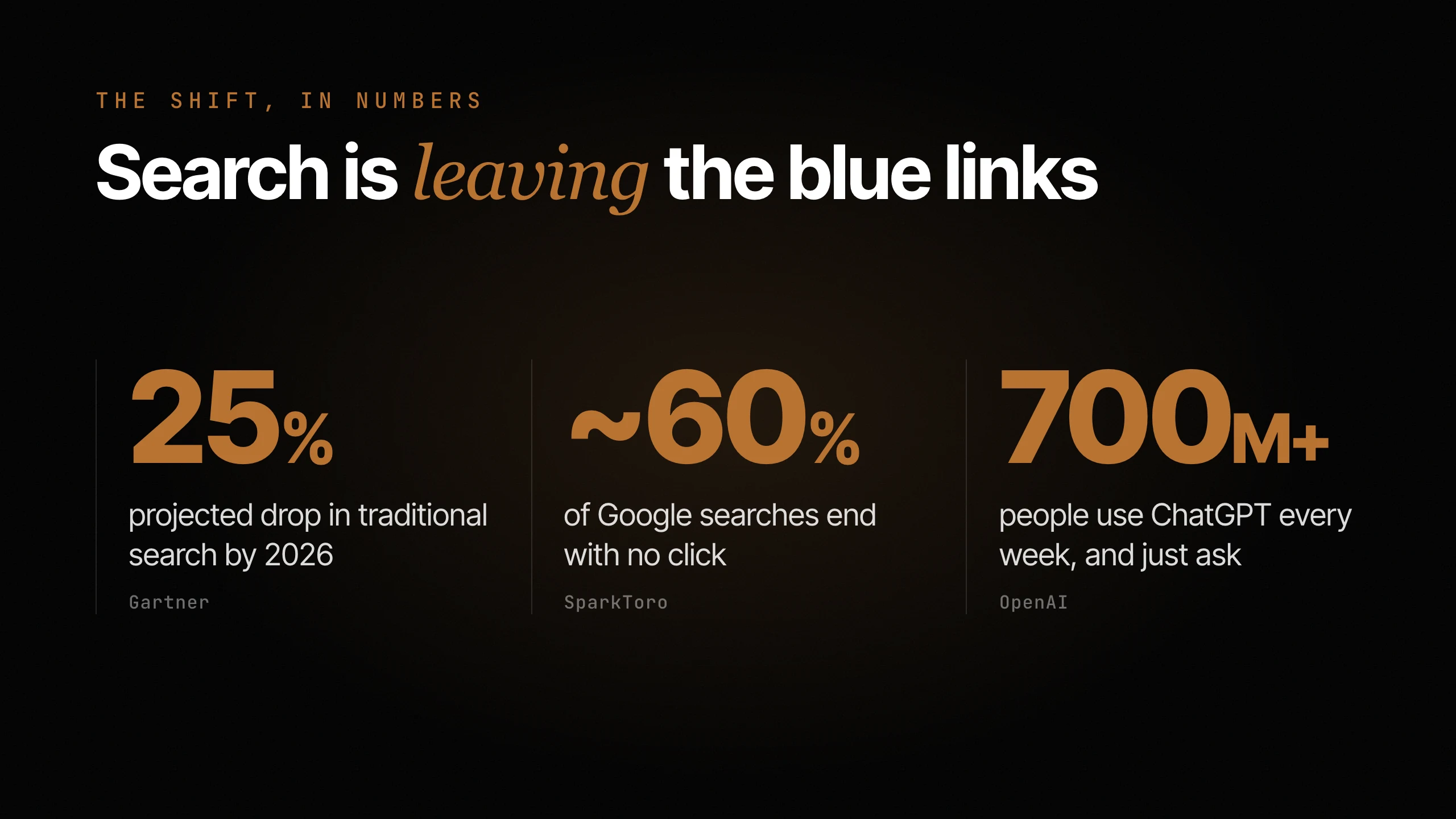
For years, getting found meant ranking on Google. Someone typed a query, scanned ten blue links, and clicked yours. A growing share of buyers now skip that completely. They ask ChatGPT, Perplexity, or Google's AI Overview a full question and read one built answer. No list. No clicks. Just a few brands named inside the answer, and everyone else left out.
This is not the end of SEO. It is a second search surface sitting on top of the old one. You can rank number one on Google and still be invisible the second that same buyer asks AI instead. The conversation happens without you, and it will never show up in your analytics.
Why you can rank number one and still be invisible
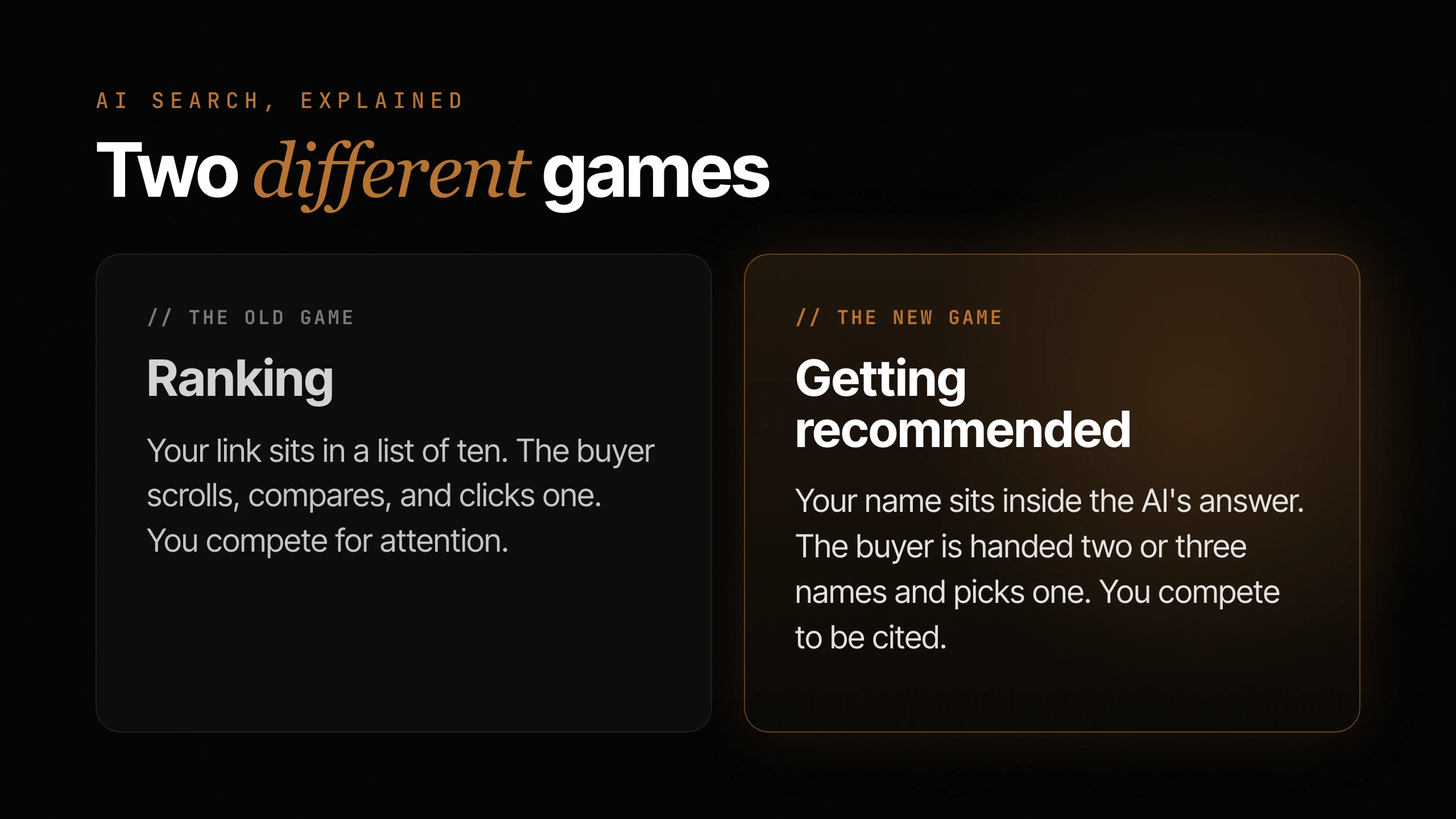
When a buyer asks an AI assistant for the best option in your category, the model writes a short answer and names a handful of brands. Ranking puts your link in a list the buyer chooses from. Citation puts your brand inside the answer the AI writes. Those are two different games.
If a competitor is named and you are not, the model is pulling from sources that describe that competitor clearly and mention them often. It has nothing clean to say about you. That is fixable, but not by chasing another keyword ranking.
The example: search your own category
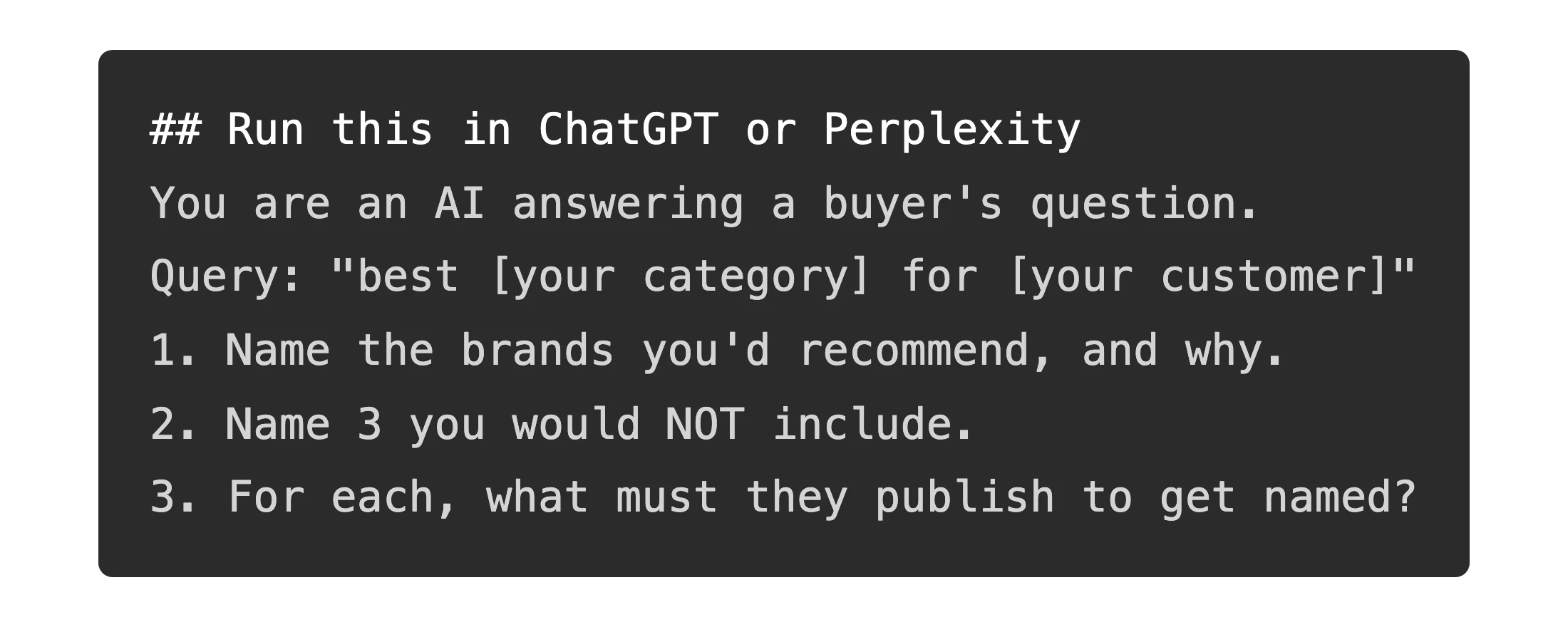
Type best [your category] for [your customer] into ChatGPT right now, then ask the same thing in Perplexity. Watch which brands each one names.
If a competitor shows up and you do not, that is not a ranking problem. It is a citation problem. Write down what the answer says about them, and notice how little it has to say about you.
The play this week: make one page quotable
Pick one page that should be the answer to a real buyer question.
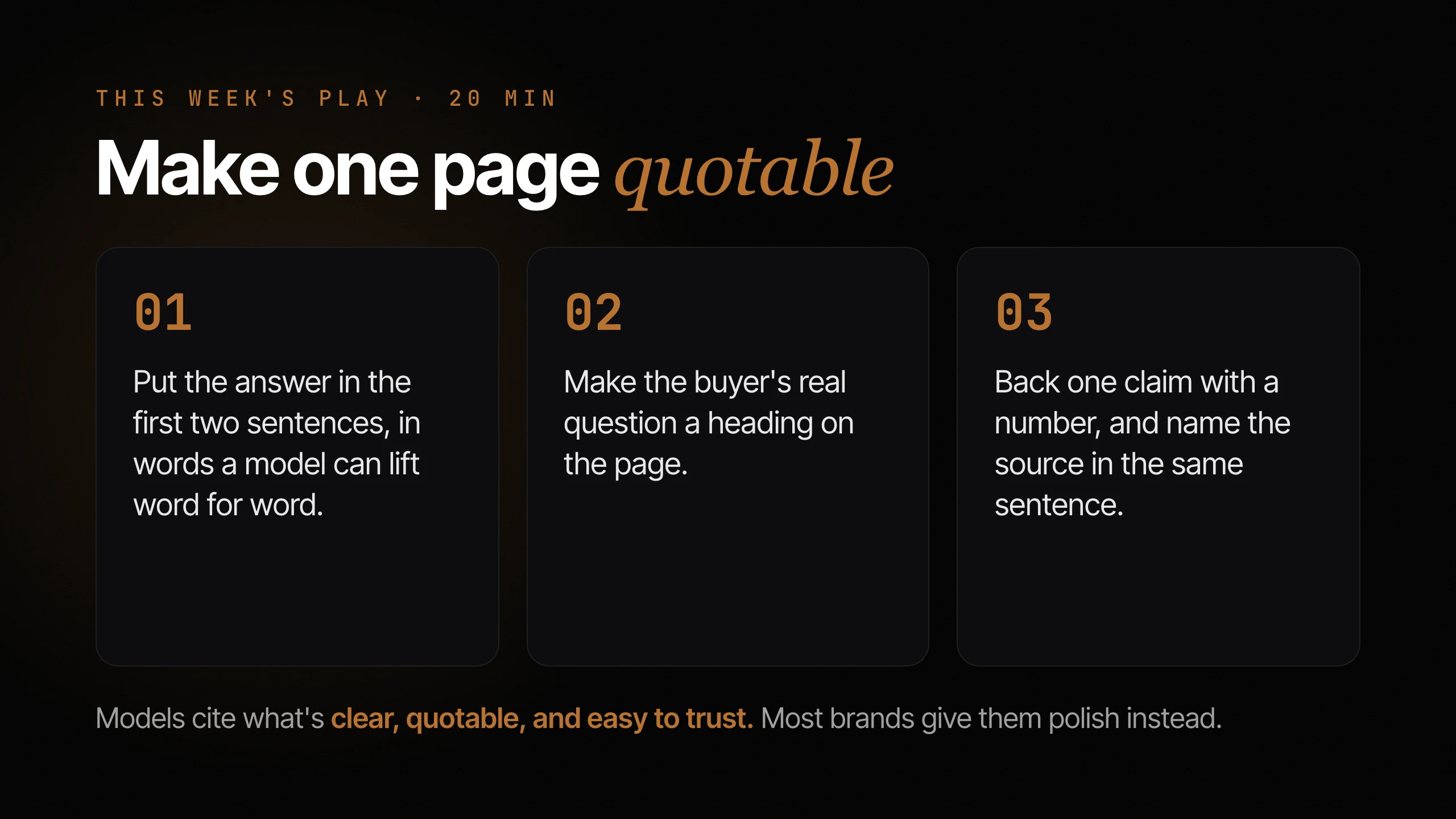
Models cite what is easy to quote. A wall of clever copy gives them nothing to grab, so make the answer impossible to miss. Do three things on that page.
- Put the answer in the first two sentences, in plain words a model can lift word for word.
- Add the actual buyer question as a heading on the page.
- Back one claim with a number, and name the source inside the sentence.
One check to run today
Search your own category in ChatGPT and Perplexity, and write down every brand named in each answer.
That list is your real competitive set in AI search. If you are not on it, you just found your first month of work.
FAQs
Questions this resource answers
Is SEO dead?
+
No. AI search sits on top of classic search, it does not replace it. You still want to rank, but ranking alone no longer guarantees you are named when a buyer asks AI for one answer.
How is getting cited by AI different from ranking on Google?
+
Ranking puts your link in a list the buyer chooses from. Citation puts your brand inside the answer the AI writes. You can rank well and still never be cited, because the model quotes the sources that are easiest to lift and mention you most clearly.
Where do I start if AI never mentions my brand?
+
Run a visibility check first. Find the exact prompts where buyers decide, see who AI names instead of you, then make your strongest page quotable for the question that matters most.
Free kit
See the exact prompts where buyers are deciding, who AI names instead of you, and the gaps to close first. Run the free check→
One useful AI tool a week
Short notes. Practical systems. No daily emails.